The Illusion of the Venture Capital Milestone
The financial markets routinely evaluate the commercial space sector through a purely speculative lens. They are stacking government contract awards against launch schedules as if aerospace scaling follows a traditional capital-intensive infrastructure model. Mainstream analysts look at a company like Intuitive Machines and evaluate its enterprise value based on NASA payload milestones. However, looking at lunar logistics through a pure physics lens exposes an entirely different competitive reality. The ultimate barrier to deep-space logistics is not a financial capital bottleneck. It is an unforgiving system-level war against raw thermodynamics and fluid dynamics in a zero-gravity vacuum.
To achieve an unshakeable infrastructure moat, an aerospace architecture must successfully navigate two conflicting physical regimes. The first is the exponential weight penalties of escaping Earth’s gravity well. The second is the radical thermal insulation demands required to store cryogenic propellants in deep space. By engineering custom low-mass structures and mastering passive radiative heat transfer, Intuitive Machines has bypassed the mechanical limitations that flatten traditional aerospace margins.
The Terrestrial Tax: Conquering the Mass Fraction
Every deep-space transit profile remains permanently shackled by the brutal, non-negotiable efficiency penalties of escaping Earth’s gravity well. This structural tax is governed directly by the Tsiolkovsky Rocket Equation:

Where 


To optimize the final mass (
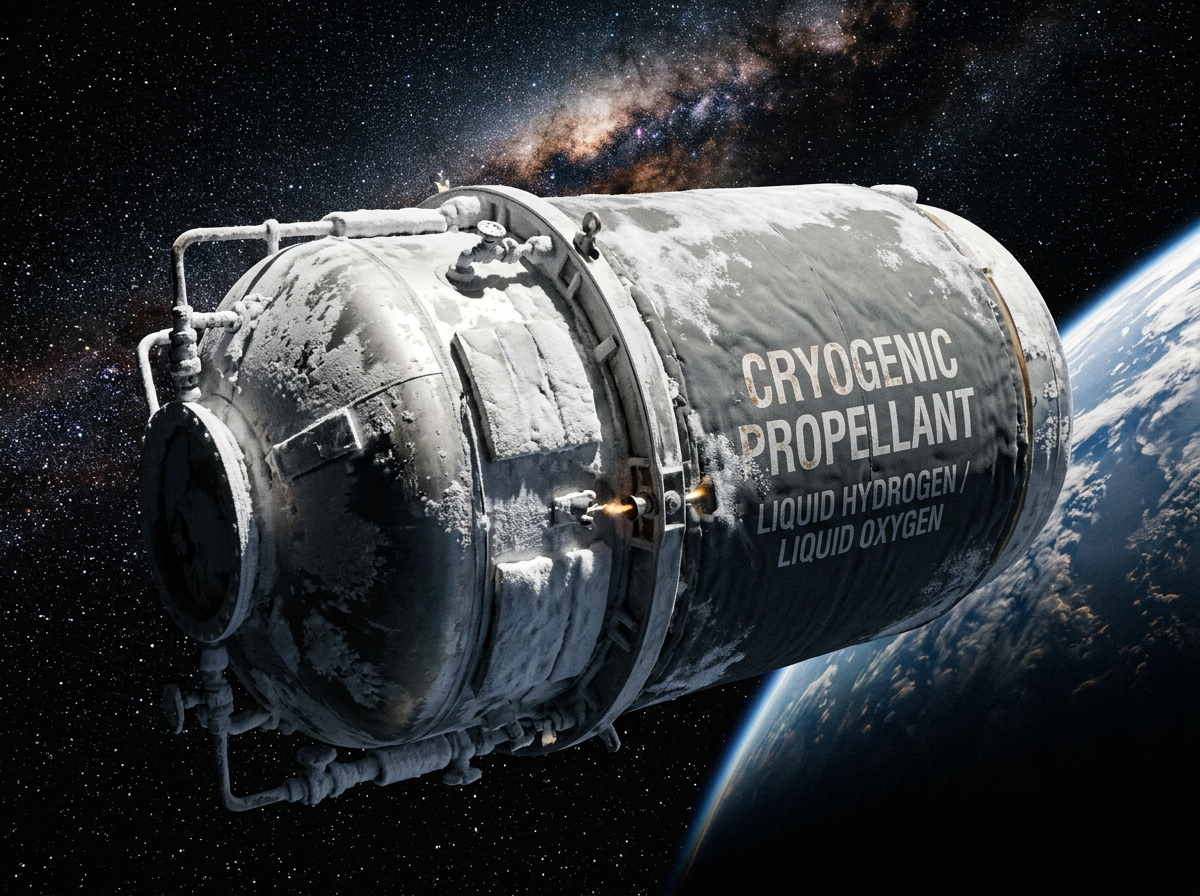
The Vacuum Crisis: Zero-G Cryogenic Boil-Off
Once the vehicle safely escapes Earth’s atmosphere and transitions into a deep-space orbital trajectory, the core engineering bottleneck shifts entirely from gravity to thermodynamics. In the vacuum of space, there is no ambient fluid or gas matrix. That means convective heat transfer drops to absolute zero. Concurrently, the spacecraft is continuously bombarded by unfiltered solar thermal radiation fields. This condition can raise the exterior skin temperature of unprotected hardware to extreme limits.
Intuitive Machines’ Nova landers rely on high-performance cryogenic propellants: liquid methane (


To solve this without adding massive, power-hungry active mechanical cooling pumps—which would violate the constraints of the rocket equation—Intuitive Machines utilizes a highly advanced passive thermal architecture driven by the Stefan-Boltzmann Radiative Law:

Where 


Intuitive Machines envelops its structural core in custom-tailored Multi-Layer Insulation (MLI) matrices designed to reflect solar photons away with near-perfect efficiency. Simultaneously, any waste internal kinetic or electronic heat generated by the lander’s subsystems is routed directly via structural heat pipes into specialized, high-emissivity (
📺 VIDEO BREAKDOWN: UNBOXING THE HARDWARE
While math defines the theoretical landscape, seeing how these physical thresholds are engineered live from the lab monitor shifts the entire economic thesis. In the technical video breakdown embedded below, we unbox the architecture of the Nova lander and run a side-by-side comparison tracking terrestrial mass penalties against deep-space radiative cooling profiles:
Enjoyed this technical analysis? Make sure to Subscribe to Infinite Square Lab on YouTube to catch our complete engineering and physics moat assets the exact second they drop.
The Ultimate System-Level Moat
The economic take-away for deep-tech allocators is clear: you cannot build a lunar logistics network out of off-the-shelf components. Software can be copied and capital can be raised. However, balancing the exponential mass constraints of the Tsiolkovsky equation with the fourth-power thermal mechanics of the Stefan-Boltzmann law requires a highly vertical, system-level architecture. Intuitive Machines’ physical moat is their proprietary knowledge of cryogenic fluid dynamics and passive thermal packaging under zero-gravity vacuum constraints. They have successfully solved the unforgiving physics of deep-space storage, positioning them as the unshakeable toll booth for the emerging lunar economy.
Help us bring deep-tech physics to the broader market. If you found value in this structural comparison, please consider sharing this post on X.
Leave a Reply