IonQ’s Atomic Moat: Trapped Ions vs. The superconducting Refrigerator
The global race for quantum supremacy is routinely evaluated by raw qubit counts. Financial analysts stack IBM’s roadmaps against Google’s announcements. They are treating quantum computing as if it follows a traditional silicon transistor scaling trajectory. However, looking at this sector through a pure physics lens exposes an entirely different competitive horizon. The ultimate barrier to a commercial quantum utility is not a software logic bottleneck; it is an existential fight against environmental noise known as quantum decoherence.
Every quantum architecture must find a way to isolate its qubits from microscopic thermal, magnetic, and mechanical fluctuations. If a single stray photon or a fractional thermal vibration interacts with a qubit, its quantum superposition state collapses—corrupting the calculation. To counter this, heavyweights like IBM and
Google have committed to a brute-force thermodynamic architecture. They are fabricating artificial superconducting circuits on solid-state chips. So, the unit needs gargantuan multi-tiered dilution refrigerators to cool them down to an unnatural state of 15 mK.
IonQ has engineered a completely parallel hardware paradigm. IBM and
Google are manufacturing highly imperfect artificial silicon circuits that require massive mechanical infrastructure to survive. However, IonQ leverages what nature has already perfected: individual, identical isotopes of elemental Ytterbium (171Yb+). By abandoning the solid-state matrix entirely, IonQ has built an architectural moat fundamentally rooted in atomic physics and integrated photonics.
The Physics of the Paul Trap: Bypassing Cryogenic Engineering
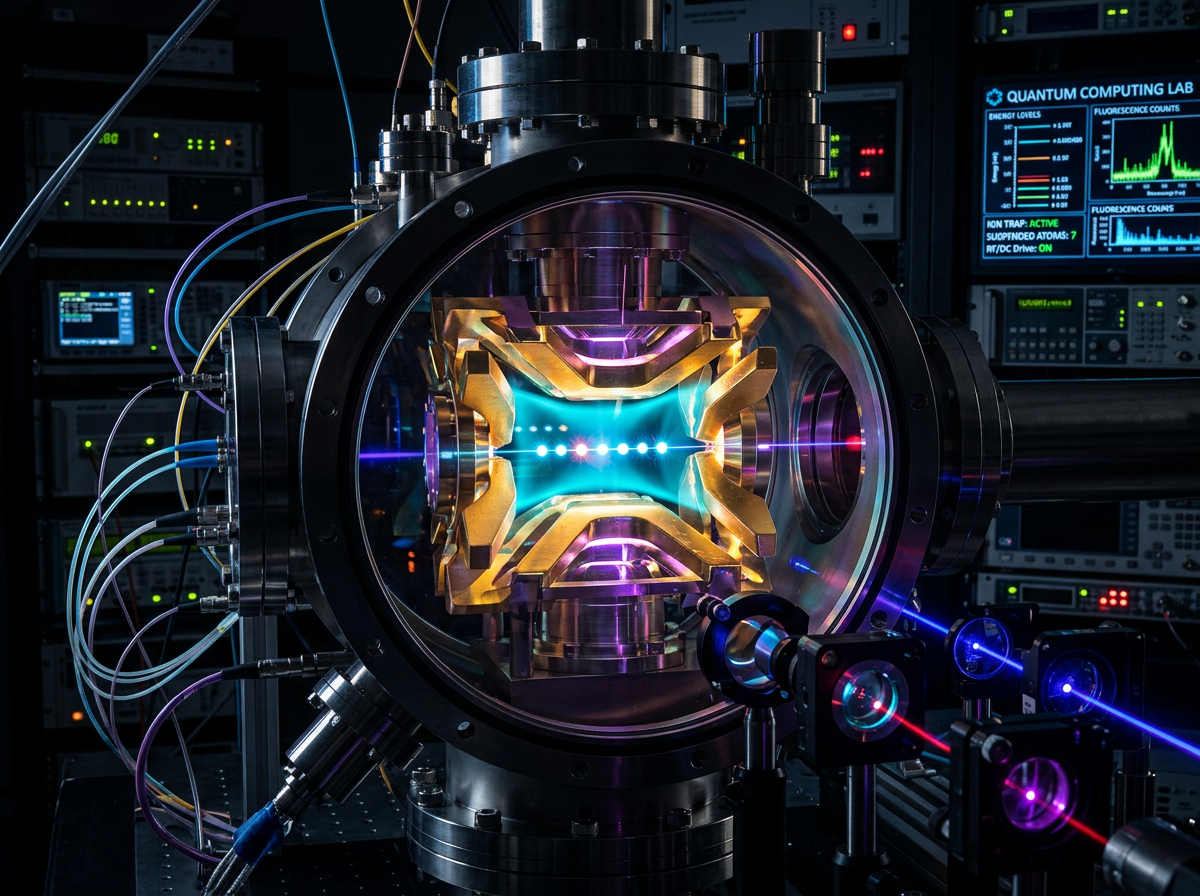
How do you stabilize, isolate, and compute with isolated atoms without allowing them to make physical contact with a macroscopic substrate? IonQ accomplishes this through the utilization of a Linear Paul Trap. This device utilizes a highly calculated configuration of electrodes to create a dynamic, localized electrodynamic environment.
In other words, the trap is applying precise radio-frequency (RF) voltages paired with static DC electric fields. So, it sets up a dynamic potential well that balances the atomic ions in mid-air inside an ultra-high vacuum chamber. This spatial stability zone is governed by the classical Mathieu Equation:
d2x / dξ2 + [ax – 2qx cos(2ξ)]x = 0
Where the parameters ax and qx dictate the strict mathematical boundaries of spatial stability for the suspended mass. Under these conditions, a chain of isolated Ytterbium ions repels each other via mutual Coulomb forces while remaining confined by the external potential well. So, the Ytterbium ions can arrange themselves into a perfectly uniform, suspended atomic crystal. Because these natural atoms are completely isolated from physical contact, they can retain their quantum coherence for extended intervals at standard room temperature. This physics moat can eliminate the need for multi-million-dollar cryogenic infrastructure.
Laser Manipulation and Photonic Waveguide Architecture
Programming a computer whose processing units are free-floating ions requires a total departure from traditional metallic wiring. Running electrical currents through copper lines causes localized heating and signal degradation. Instead, IonQ utilizes highly focused, phase-modulated laser arrays to initialize, manipulate, and read out individual quantum states.
To execute a quantum logic operation, targeted laser pulses impart precise momentum to specific ions. This couples the internal electronic states of the individual atoms to the collective vibrational modes—called phonons—shared across the entire trapped chain. The speed and rotation of these quantum logic state transformations are governed by the Rabi Frequency:
Ω = (d · E0) / ħ
Where d represents the transition dipole matrix element of the Ytterbium atom, and E0 is the electric field amplitude of the steering laser pulse. By controlling the duration and phase of these laser interactions, IonQ can perform arbitrary single-qubit rotations and multi-qubit entangling gates across any pair in the line.
While silicon-based quantum computing tracks a heavy mechanical scaling path, trapped-ion computing shifts the challenge entirely to high-precision optics. To truly appreciate how this atomic architecture completely alters the engineering economics of quantum tech, we must look at the real-world physical limits of both tracks. In the technical video breakdown embedded below, we unbox IonQ’s Linear Paul Trap and compare it side-by-side with the cooling limits of superconducting systems live from the lab monitor:
The Long-Term Scaling Moat: From Lab Benches to Photonic Interconnects
Solid-state quantum computing faces an immediate manufacturing crisis: no two fabricated silicon qubits are perfectly identical down to the atomic level, meaning every chip requires localized calibration to counteract physical defects. Conversely, every Ytterbium ion in the universe is structurally identical by cosmic definition. IonQ’s true long-term scaling moat is not an infrastructure challenge of cooling larger systems; it is an optical integration challenge. By transitioning from large laboratory laser setups to specialized photonic chips with embedded evanescent waveguides, IonQ is shifting quantum scaling into an advanced optical lithography game—leveraging the exact same semiconductor manufacturing ecosystems that drive advanced optical networking.
Enjoyed this technical analysis? Subscribe to Infinite Square Lab on YouTube to receive our complete media assets directly as they drop.
Help us bring deep-tech physics to the broader market. If you found value in this structural comparison, please consider sharing this post on X.
Leave a Reply