Date: January 19, 2026
Category: Deep Tech & Stock Analysis
Reading Time: 5 mins
Most investors look at a company’s P/E ratio or revenue growth. But as a physicist, I look at something else: The Rayleigh Criterion.
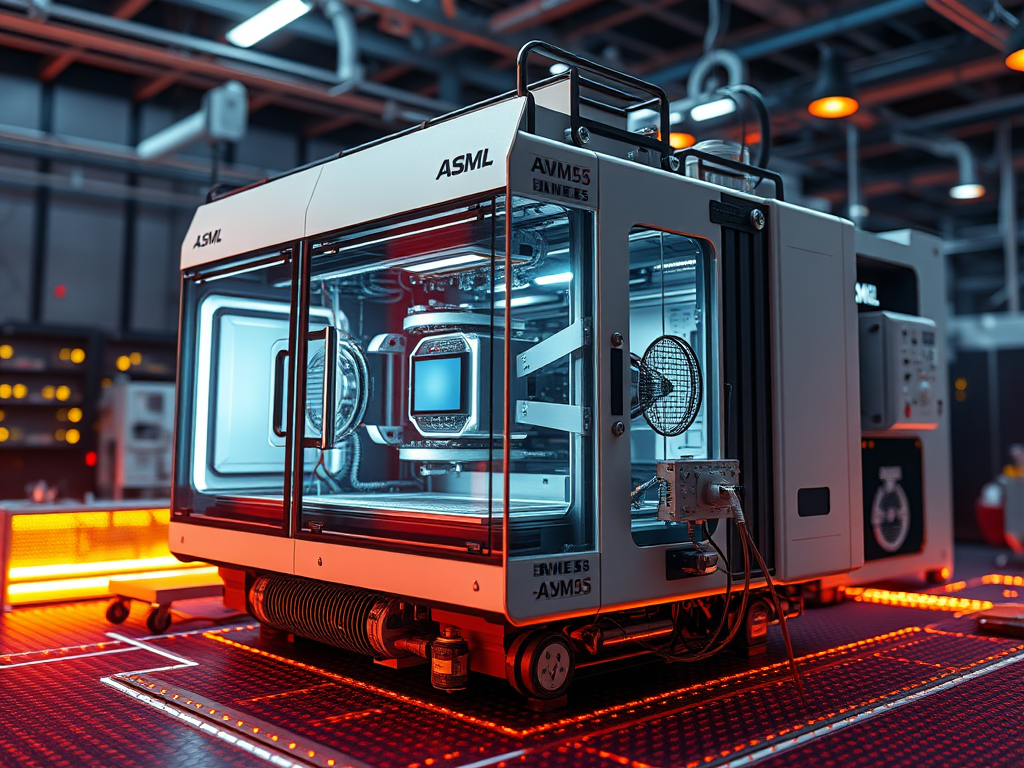
Today, I want to talk about ASML (NASDAQ: ASML). While the world is obsessed with AI chips from NVIDIA, those chips cannot exist without a single machine made by a single company in the Netherlands. In 2026, ASML has moved into the “High-NA” era, and the physics behind it is why I believe they have the strongest competitive moat in human history.
1. The Physics: Breaking the Rayleigh Limit
In my doctoral courses, we spent a lot of time on wave optics. To make smaller transistors, you need a smaller “pencil” to draw them. The limit of how small you can go is defined by the Rayleigh Criterion:

- CD (Critical Dimension): The smallest feature you can print.
- λ (Lambda): The wavelength of light.
- NA (Numerical Aperture): The “light-gathering” power of the lens.
ASML already conquered the λ part by using Extreme Ultraviolet (EUV) light at 13.5 nm (which is so energetic it is absorbed by almost everything, including air—hence the need for a vacuum).
But in 2026, the story is all about the NA. ASML’s new “High-NA” machines have increased the aperture from 0.33 to 0.55. To an investor, that looks like a 0.22 increase. To a physicist, that is a 1.7x improvement in resolution and a 2.9x increase in transistor density.
2. Why This is a “Moat” (The Business Perspective)
From a stock research perspective, “High-NA” is a game changer for two reasons:
- Single Patterning vs. Multi-Patterning: Without High-NA, chipmakers like TSMC and Intel have to use “multi-patterning”—basically drawing the same circuit multiple times to get the resolution right. It’s expensive, slow, and ruins “yield” (the percentage of working chips). High-NA allows them to do it in one pass.
- Zero Competition: Canon and Nikon gave up on EUV years ago because the physics was too hard. ASML has a 100% market share in the machines required to make 2nm and 1.4nm chips.
3. Financial Outlook for 2026
As of January 2026, ASML’s order book is surging. Why? Because the “AI Arms Race” has moved from software to hardware.
- TSMC’s 2nm ramp: TSMC is reportedly sold out of 2nm capacity for the year. To fulfill those orders, they must buy more ASML scanners.
- The Price Tag: Each High-NA machine costs roughly $380 million. These are not just machines; they are capital-intensive infrastructure.
The Physicist’s Verdict
In the stock market, “uncertainty” is usually seen as a risk. But the laws of physics are certain. Moore’s Law is not dead—it has just become a “Physics Tax” that every chipmaker must pay to ASML.
If you believe AI will continue to grow, you are essentially betting on the continued success of EUV lithography.
“Discussion continues on X. Join the thread here https://x.com/InfiniteSqLab“
“While financial analysts often focus on ASML’s order book, the real story is written in the laws of physics. To truly understand why this company holds a global monopoly on the future of AI, you have to look at how they’ve engineered their way around the diffraction limit of light. In the video below, I unbox the specific ‘Physics Moat’ behind High-NA EUV and why it’s the most complex machine in human history:”
Can’t watch right now? Subscribe to Infinite Square Lab on YouTube to save this deep dive for later.
“If you found this analysis of ASML’s ‘Physics Moat’ valuable, [click here to share it on X] and help other investors understand the hard science behind the semiconductor monopoly.”
Leave a Reply